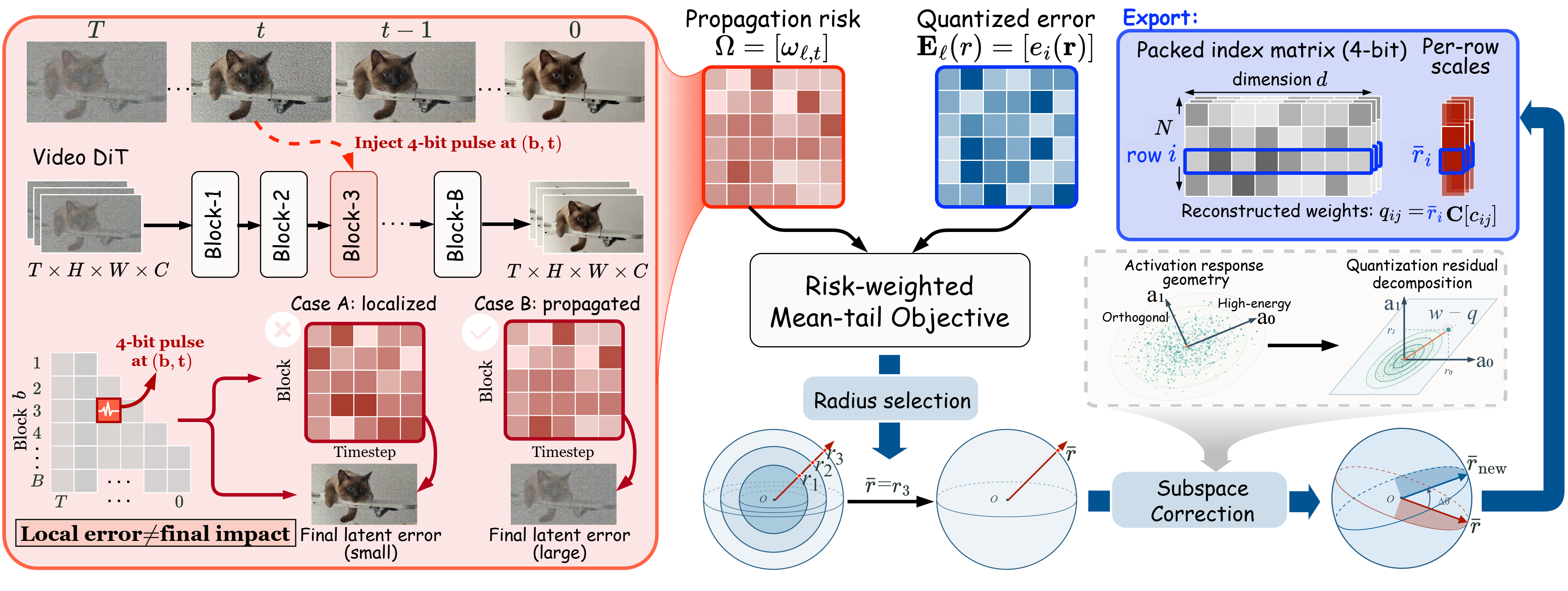
Account for how later denoising steps amplify or attenuate quantization errors.
Abstract
Quantization errors in video diffusion transformers can be amplified or attenuated by subsequent denoising updates, making local reconstruction error an incomplete predictor of final impact. We introduce PulseQuant, a 4-bit post-training quantization method that combines trajectory sensitivity with activation geometry to guide offline calibration. Isolated block–step interventions estimate propagation risk, which prioritizes sensitive trajectory states during row-radius selection. With these radii fixed, response-subspace correction uses neighboring-code edits to reduce residual components along dominant activation directions. Both stages preserve the original 4-bit weight representation. Controlled interventions show that short-horizon propagated error predicts final latent error more reliably than immediate block-output error, supporting calibration beyond local reconstruction objectives. Evaluations on Wan models, Self Forcing, and MiniMax-H3 demonstrate improvements in key consistency and dense-reference metrics while remaining competitive on other attributes across model scales and generation paradigms.
Refine 4-bit weights in activation directions that matter to layer outputs.
Explore results on Wan 2.1, Wan 2.2, MiniMax-H3, and Self-Forcing.
See the difference
Video comparisons
Explore 35 examples across seven model and precision settings. Play each row together to compare PulseQuant with the dense BF16 reference and other quantization methods. W4A4 / W4A6 denotes 4-bit weights with 4-bit / 6-bit activations.
MiniMax-H3 W4A4
5 selected examplesVictorian house
Read full prompt
3D model of a 1800s Victorian house, standing tall and grand amidst a lush green garden. The house features a slate roof with intricate chimney pots and ornate bay windows. It has a symmetrical facade with columns supporting a portico entrance. The exterior is painted a deep burgundy color with golden accents. The windows are adorned with intricate ironwork and stained glass depicting floral patterns. Ivy climbs up the walls, intertwining with ivy-covered railings. A cobblestone path leads to the front door, lined with flower boxes filled with vibrant flowers. Inside, the foyer opens to a spacious living room with high ceilings, ornate chandeliers hanging from the ceiling, and richly carved wooden floors. The walls are adorned with oil paintings of historical figures and landscapes. A grand staircase with marble railings rises to the second floor, leading to bedrooms and a library. The house stands proudly in the midst of well-tended gardens, with a small pond and a statue of a knight guarding the entrance. The overall scene exudes elegance and charm, capturing the essence of the Victorian era. Medium shot interior view with focus on the grand foyer and detailed architectural elements.
Dense BF16
Dense reference
PulseQuant (Ours)
PSNR 13.89 · SSIM 0.303
OrbitQuant
PSNR 11.50 · SSIM 0.169
ViDiT-Q
PSNR 12.40 · SSIM 0.203
Yellow flowers
Read full prompt
Yellow flowers gently swaying in the breeze, their vibrant petals dancing with each gentle gust. The flowers are large and daisy-like, with soft yellow centers surrounded by feathery yellow petals. They sway gracefully in a field of green grass, with a slight breeze blowing from the right side. The sky is a clear, sunny blue, with fluffy white clouds floating lazily across the horizon. A small wooden fence frames the scene, adding a touch of rustic charm. The sun casts a warm glow over everything, creating a peaceful and serene atmosphere. Soft, natural lighting fills the frame, highlighting the beauty of the flowers and the lush green surroundings. The composition is balanced, with the flowers at the center, the fence on the left, and the sky and clouds on the right. The focus is on the movement of the flowers, captured with smooth, fluid camera movements. Medium shot, low-angle view.
Dense BF16
Dense reference
PulseQuant (Ours)
PSNR 15.62 · SSIM 0.561
OrbitQuant
PSNR 12.94 · SSIM 0.462
ViDiT-Q
PSNR 12.43 · SSIM 0.493
Airplane in flight
Read full prompt
CG animation digital art, an airplane soaring gracefully through a crystal-clear blue sky. The plane is a sleek silver jet with modern design, its wingspan wide as it cuts through the air smoothly. It is surrounded by fluffy white clouds that gently follow its path, creating a serene and peaceful atmosphere. The sun shines brightly in the distance, casting a warm golden glow. The background features vast open fields and small towns below, with distant mountains forming a beautiful horizon. The airplane is captured in a low-angle shot from behind, emphasizing its speed and altitude. Motion-blur effect to convey the movement of the plane.
Dense BF16
Dense reference
PulseQuant (Ours)
PSNR 16.16 · SSIM 0.698
OrbitQuant
PSNR 13.84 · SSIM 0.638
ViDiT-Q
PSNR 11.71 · SSIM 0.588
Cat in a meadow
Read full prompt
A playful feline sprinting joyfully across a lush green meadow dotted with wildflowers. The cat has sleek fur, expressive green eyes, and a fluffy tail that wags excitedly as it bounds forward. The meadow stretches out behind it, with vibrant sunflowers and buttercups swaying gently in the breeze. The sky above is a bright azure, filled with fluffy white clouds. The cat's joyful run is captured from a dynamic low-angle perspective, showcasing its agility and boundless energy. The scene is bathed in warm golden light, enhancing the cat's lively demeanor. Grass and petals trail behind the cat as it dashes towards the horizon. The background features a serene rural landscape, with small cottages and winding country roads visible in the distance. The overall composition is energetic and full of life, perfectly capturing the essence of a cat running happily.
Dense BF16
Dense reference
PulseQuant (Ours)
PSNR 16.17 · SSIM 0.545
OrbitQuant
PSNR 13.02 · SSIM 0.442
ViDiT-Q
PSNR 12.28 · SSIM 0.426
Zebra on the savanna
Read full prompt
CG game concept digital art, a majestic zebra with a sleek black and white striped pattern, taking a peaceful walk across a vast savanna. The zebra stands tall with its head held high, walking slowly through tall grass and sparse trees. The sun sets behind the zebra, casting a warm golden glow over the landscape. The sky is filled with fluffy white clouds, adding a soft and serene atmosphere. The zebra moves gracefully, with each step carefully measured, as it explores its surroundings. The savanna is dotted with small wildflowers and scattered with ancient-looking rocks. In the distance, a herd of other zebras can be seen grazing peacefully. The overall scene is tranquil and beautiful. Low-angle view, medium shot focusing on the zebra's face and posture.
Dense BF16
Dense reference
PulseQuant (Ours)
PSNR 14.08 · SSIM 0.455
OrbitQuant
PSNR 11.28 · SSIM 0.391
ViDiT-Q
PSNR 10.86 · SSIM 0.412
1 / 5
MiniMax-H3 W4A6
5 selected examplesBeach at sunset
Read full prompt
Beachside scene captured during sunset, featuring a young woman with sun-kissed skin and tousled sandy blonde hair. She is wearing a flowing, turquoise-colored sundress with delicate floral patterns and a matching wide-brimmed straw hat adorned with a small flower. Her expressive brown eyes are framed by long lashes, and she has a serene yet playful smile. She is lounging on a plush, striped towel, positioned under a large umbrella providing shade. A calm ocean breeze rustles the palm leaves nearby. In the background, a picturesque coral reef can be seen reflecting the warm hues of the setting sun. The sky is painted with soft shades of orange and pink, blending seamlessly into the deep blue of the horizon. Soft, dreamy lighting and gentle waves create a tranquil atmosphere. The scene captures the essence of a leisurely summer day at the beach. Medium shot, half-body portrait, with focus on the woman's joyful expression and the serene environment. Gentle camera movement following the woman as she enjoys the moment.
Dense BF16
Dense reference
PulseQuant (Ours)
PSNR 18.54 · SSIM 0.629
OrbitQuant
PSNR 13.91 · SSIM 0.462
ViDiT-Q
PSNR 12.31 · SSIM 0.459
Office scene
Read full prompt
Office interior scene captured in high-definition, a professional office worker typing on a laptop computer at their desk. The worker is a middle-aged woman with shoulder-length brown hair tied up in a neat ponytail. She is wearing a tailored grey business suit with a white blouse underneath, and black leather shoes. Her face shows determination and focus as she concentrates on her work. The background features a cluttered desk with stacks of paperwork, open files, and a coffee mug. The lighting is soft and warm, highlighting the worker's determined expression. The room has a modern and organized aesthetic. Medium shot from the side, capturing the worker's full body.
Dense BF16
Dense reference
PulseQuant (Ours)
PSNR 15.58 · SSIM 0.539
OrbitQuant
PSNR 10.78 · SSIM 0.378
ViDiT-Q
PSNR 13.20 · SSIM 0.427
A cup on the table
Read full prompt
CG game concept digital art, a tranquil tableau featuring a serene cup resting on a polished wooden surface. The cup is made of delicate porcelain, with intricate hand-painted designs in shades of pale blue and green. It sits gracefully on a small, intricately carved wooden coaster. The wooden surface is smooth and gleaming, with subtle grain patterns. Soft, warm ambient lighting casts gentle shadows, highlighting the intricate details of the cup and the coaster. The background is a minimalist, softly textured room with hints of pastel colors, creating a peaceful and serene atmosphere. Low-angle view, medium shot focusing on the detailed cup.
Dense BF16
Dense reference
PulseQuant (Ours)
PSNR 20.30 · SSIM 0.769
OrbitQuant
PSNR 16.63 · SSIM 0.698
ViDiT-Q
PSNR 14.85 · SSIM 0.723
Bicycle in the snow
Read full prompt
A whimsical winter scene captured in high-definition, a sleek black bicycle gracefully glides through a pristine snowy field. The snow-covered ground sparkles under the soft glow of a warm sunset. The bicycle has intricate patterns and accents in silver and gold, reflecting the sunlight beautifully. A young girl, with wavy blonde hair tied into a ponytail, is riding the bike, her expression filled with joy and excitement. She wears a cozy red coat and matching mittens, and a pair of stylish black boots. The field is dotted with small, colorful wildflowers, adding a pop of vibrant hues against the white backdrop. The sky is painted with soft, fluffy clouds, hinting at a gentle breeze. The background showcases a blend of natural and artificial elements, including a few scattered wooden fences and a quaint wooden barn in the distance. The camera moves smoothly from a wide angle capturing the vast expanse of the snowy field to a closer perspective on the girl and the bicycle, emphasizing their dynamic interaction. The overall scene exudes a sense of tranquility and adventure, perfect for an animated winter tale.
Dense BF16
Dense reference
PulseQuant (Ours)
PSNR 14.93 · SSIM 0.592
OrbitQuant
PSNR 12.30 · SSIM 0.532
ViDiT-Q
PSNR 10.98 · SSIM 0.481
Bear in the forest
Read full prompt
CG game concept digital art, a majestic brown bear standing tall in a dense forest clearing. The bear has shaggy fur and powerful jaws, ready to catch a large salmon in its mouth. The salmon is wriggling in the bear's jaws, its scales shimmering under the soft forest light. The bear's eyes are focused and determined, its muscles rippling with strength. The forest backdrop features tall pine trees, fallen leaves, and a clear stream nearby. The bear stands with its front paws raised, about to pounce. The salmon lies motionless on the ground, its scales reflecting the sunlight. Dark shadows from the trees add depth to the scene. Low-angle, wide-shot view.
Dense BF16
Dense reference
PulseQuant (Ours)
PSNR 18.31 · SSIM 0.541
OrbitQuant
PSNR 15.96 · SSIM 0.472
ViDiT-Q
PSNR 15.09 · SSIM 0.397
1 / 5
Wan 2.2-A14B W4A4
5 selected examplesCity parking lot
Read full prompt
In a still frame of a bustling city parking lot, illuminated by soft streetlights casting warm hues over parked cars of various colors and models. A mix of modern sedans, SUVs, and classic vehicles stand side by side. The ground is covered with neatly arranged trash cans and empty parking spaces. In the foreground, a lone figure stands, leaning against the side of a car, wearing a casual hoodie and jeans. Their expression is contemplative, with a slight frown. They hold a smartphone in one hand and a coffee cup in the other. The background features a mix of old and new buildings, with signs of graffiti and advertisements. The scene captures the quiet moments between busy activities in a typical urban setting. Single shot, medium angle, focusing on the figure.
Dense BF16
Dense reference
PulseQuant (Ours)
PSNR 18.66 · SSIM 0.632
OrbitQuant
PSNR 15.63 · SSIM 0.458
ViDiT-Q
PSNR 16.20 · SSIM 0.444
Vintage gas lantern
Read full prompt
Vintage gas lantern, intricately detailed and glowing warmly, stands proudly in the center of a quaint cobblestone square lined with ancient buildings. The lantern casts soft, amber light over the cobblestones, highlighting the weathered stones and worn-out bricks. The square is bustling with life, people walking slowly, talking in hushed tones, and children playing amidst the old-world charm. The lantern's flickering light dances on the faces of the passersby, casting gentle shadows. The lantern is made of brass and copper, with ornate carvings depicting scenes from history. The square is filled with the scent of freshly baked bread and the sound of street musicians playing traditional tunes. Historic architecture surrounds the square, including a grand cathedral and a quaint market with colorful stalls. The lantern is held aloft by a skilled artisan, who expertly adjusts the wick to keep the flame burning brightly. The scene is captured in a still frame, emphasizing the beauty and tranquility of this historical moment.
Dense BF16
Dense reference
PulseQuant (Ours)
PSNR 16.69 · SSIM 0.537
OrbitQuant
PSNR 12.59 · SSIM 0.238
ViDiT-Q
PSNR 13.28 · SSIM 0.240
Elephant spraying water
Read full prompt
CG animation digital art, an African elephant standing in a lush green savanna, using its trunk to spray itself with water from a nearby watering hole. The elephant has a sleek, grey coat with slight spots, and its trunk is long and flexible. It is mid-spray, the water droplets flying off in all directions. The savanna is filled with tall grasses and scattered trees. In the background, a few birds are perched on branches. Soft lighting highlights the textures of the elephant's skin and fur. Low-angle shot, focusing on the elephant's entire body, emphasizing the intricate details of its trunk and the droplets of water.
Dense BF16
Dense reference
PulseQuant (Ours)
PSNR 16.99 · SSIM 0.567
OrbitQuant
PSNR 12.41 · SSIM 0.317
ViDiT-Q
PSNR 12.50 · SSIM 0.334
Futuristic laboratory
Read full prompt
CG game concept digital art, a dimly lit laboratory filled with advanced machinery and equipment. The walls are lined with shelves holding various scientific instruments and books. A large microscope sits on a nearby table, with a slide under the lens. The air is thick with the scent of chemicals and burning substances. Dr. Frankencastle, a tall man with slicked-back black hair and a stern expression, stands at the center of the room, examining a specimen under the microscope. He wears a lab coat with the company logo, and his hands are covered in grease. The floor is covered in a thin layer of dust, and there are scattered papers and notes around the room. The lighting is harsh and focused, highlighting every detail. The background features a distant silhouette of a city skyline. Low-angle, close-up view.
Dense BF16
Dense reference
PulseQuant (Ours)
PSNR 17.26 · SSIM 0.611
OrbitQuant
PSNR 11.78 · SSIM 0.319
ViDiT-Q
PSNR 14.46 · SSIM 0.461
Windmill in a field
Read full prompt
CG animation digital art, a majestic windmill standing tall in a vast open field. The windmill has intricate wooden blades rotating gently in the breeze, casting shadows across the golden wheat fields below. The sky is a clear blue with fluffy white clouds drifting lazily by. The windmill's tower is adorned with colorful stained glass windows depicting scenes of nature and agriculture. In the foreground, a small herd of cows graze peacefully under the watchful gaze of a farmer standing near the base of the windmill. The field is dotted with wildflowers and scattered with old farm equipment. Soft, warm sunlight filters through the blades, creating a serene and tranquil atmosphere. Low-angle view, focus on the windmill and the peaceful scene below.
Dense BF16
Dense reference
PulseQuant (Ours)
PSNR 16.57 · SSIM 0.602
OrbitQuant
PSNR 14.52 · SSIM 0.563
ViDiT-Q
PSNR 13.04 · SSIM 0.483
1 / 5
Wan 2.1-14B W4A4
5 selected examplesDesert sandstone arch
Read full prompt
A tranquil tableau in the heart of the Utah desert, a massive sandstone arch spans the horizon. The arch stands tall and weathered, its surface covered in intricate patterns of erosion and time. Golden hues of sunset illuminate the scene, casting long shadows across the surrounding dry landscape. In the foreground, small cacti stand proudly, their spines glistening in the fading light. A lone figure, perhaps a hiker or a photographer, stands at the base of the arch, capturing the serene beauty of the desert. They wear a neutral-colored outfit, blending seamlessly into the surroundings, and hold a camera, ready to capture every moment. The background features vast expanses of golden sand stretching towards the horizon, dotted with sparse vegetation and the occasional rock formation. The overall scene exudes tranquility and the raw beauty of nature, inviting viewers to feel a sense of awe and peace. Medium shot, wide-angle lens capturing the full arch and the hiker.
Dense BF16
Dense reference
PulseQuant (Ours)
PSNR 19.09 · SSIM 0.664
OrbitQuant
PSNR 13.27 · SSIM 0.542
ViDiT-Q
PSNR 13.46 · SSIM 0.473
Bear in the forest
Read full prompt
CG game concept digital art, a majestic brown bear standing tall in a dense forest clearing. The bear has shaggy fur and powerful jaws, ready to catch a large salmon in its mouth. The salmon is wriggling in the bear's jaws, its scales shimmering under the soft forest light. The bear's eyes are focused and determined, its muscles rippling with strength. The forest backdrop features tall pine trees, fallen leaves, and a clear stream nearby. The bear stands with its front paws raised, about to pounce. The salmon lies motionless on the ground, its scales reflecting the sunlight. Dark shadows from the trees add depth to the scene. Low-angle, wide-shot view.
Dense BF16
Dense reference
PulseQuant (Ours)
PSNR 17.72 · SSIM 0.522
OrbitQuant
PSNR 14.76 · SSIM 0.312
ViDiT-Q
PSNR 13.15 · SSIM 0.298
Desert oasis
Read full prompt
In a still frame, amidst the vast desert landscape, a tranquil oasis stands out with tall, majestic palm trees swaying gently in the breeze. The oasis is nestled among golden sand dunes, creating a serene and peaceful atmosphere. The air is filled with the sweet scent of blooming flowers and the sound of trickling water from a nearby spring. A lone camel rests by the edge of the oasis, its soft brown coat blending seamlessly with the surrounding environment. In the distance, the sun sets behind the horizon, casting a warm golden hue over everything. The oasis is surrounded by lush greenery and vibrant flora, with a small pond reflecting the beautiful sky. The scene captures a moment of tranquility and nature's beauty, with a focus on the contrast between the harsh desert and the oasis's serenity. Desert sunset backdrop with palm trees and gentle breeze.
Dense BF16
Dense reference
PulseQuant (Ours)
PSNR 20.05 · SSIM 0.668
OrbitQuant
PSNR 14.85 · SSIM 0.545
ViDiT-Q
PSNR 12.66 · SSIM 0.439
Turquoise splash
Read full prompt
Splash of turquoise water in extreme slow motion, capturing every ripple and bubble. The water surface is perfectly still except for the initial splash, which expands slowly across the frame. The alpha channel is included for easy compositing. The scene is set against a backdrop of a calm, clear sky and gently swaying grass. The water depth varies, creating depth and dimension. The camera captures the splash from multiple angles, including a high angle view of the entire splash, a mid-shot focusing on the center of the splash, and a close-up on a single bubble forming. The water splashes onto a sandy beach, highlighting the texture of the sand as it absorbs the water. The overall scene is in vibrant turquoise hues, emphasizing the contrast between the cool water and warm sand. The splash creates a mesmerizing effect, drawing the viewer into the moment.
Dense BF16
Dense reference
PulseQuant (Ours)
PSNR 16.68 · SSIM 0.657
OrbitQuant
PSNR 14.39 · SSIM 0.525
ViDiT-Q
PSNR 12.91 · SSIM 0.472
Panda in a classroom
Read full prompt
A confused panda student wearing a classic academic outfit, sitting at a wooden desk in a traditional classroom setting. The classroom is filled with rows of desks, each occupied by students engrossed in their textbooks. The panda has a large backpack slung over one shoulder, holding a heavy-looking calculus textbook. It squints at the chalkboard, which displays complex equations and formulas. The room is dimly lit with soft, warm lighting highlighting the panda's puzzled expression. A whiteboard marker lies discarded beside the desk. The background features neatly arranged books and scattered papers on other desks. The scene captures the panda's struggle with understanding the material, with subtle hints of motion indicating the teacher's pacing and the students' attentiveness. Soft ambient sounds of pencil scratching and occasional whispers fill the air. The overall atmosphere is one of quiet concentration and academic rigor.
Dense BF16
Dense reference
PulseQuant (Ours)
PSNR 19.10 · SSIM 0.675
OrbitQuant
PSNR 14.23 · SSIM 0.491
ViDiT-Q
PSNR 12.58 · SSIM 0.408
1 / 5
Self Forcing W4A4
5 selected examplesCountryside farmhouse
Read full prompt
A tranquil tableau of a quaint farmhouse nestled in a serene countryside landscape. The farmhouse stands tall and sturdy, with a weathered wooden exterior painted a soft gray. It has a wraparound porch with rocking chairs, and climbing roses cover the fence. A gentle breeze rustles through the nearby apple trees. The sky is a peaceful shade of blue, dotted with fluffy white clouds. A family gathers on the porch, enjoying a cup of tea and watching the sunset. They are all smiling warmly at each other. The scene captures the essence of a peaceful domestic life. Soft natural lighting enhances the atmosphere. Wide shot of the entire scene, focusing on the farmhouse and the family.
Dense BF16
Dense reference
PulseQuant (Ours)
PSNR 17.30 · SSIM 0.470
ViDiT-Q
PSNR 13.89 · SSIM 0.319
SVDQuant
PSNR 13.49 · SSIM 0.353
Bear in a wet forest
Read full prompt
CG game concept digital art, a large brown bear standing tall in a dense forest clearing, its fur matted and sleek from recent rain. The bear's eyes are focused intently on a small deer hidden amongst the underbrush. It shifts its weight from one leg to the other, preparing to pounce. Thick undergrowth surrounds the bear, creating dynamic shadows and textures. In the background, towering ancient trees loom ominously. The bear's claws dig deep into the earth, muscles rippling beneath its thick fur. It holds its breath, ears twitching, ready to spring at any moment. Low-angle shot, close-up focus on the bear's determined gaze.
Dense BF16
Dense reference
PulseQuant (Ours)
PSNR 13.95 · SSIM 0.252
ViDiT-Q
PSNR 12.89 · SSIM 0.163
SVDQuant
PSNR 12.76 · SSIM 0.204
Cyberpunk robot
Read full prompt
Cyberpunk-inspired visual style, a towering super cool giant robot standing in the heart of futuristic Cyberpunk Beijing. The robot has sleek, metallic body with glowing neon lights and intricate circuitry patterns. It stands tall amidst the bustling cityscape, towering over skyscrapers and neon-lit streets. The background features a blend of retro and modern elements, with neon signs, flying cars, and towering skyscrapers. The robot's eyes glow intensely with a fierce determination, as it scans the city with its advanced sensors. It holds a large energy weapon in one hand, ready to defend the city from any threats. The robot's mechanical limbs move smoothly, reflecting the high-tech and futuristic atmosphere. The scene captures a moment of intense action, with people rushing by in various directions. The lighting is dim, with soft shadows highlighting the robot's imposing presence. The overall feel is gritty and exhilarating, showcasing the power and resilience of advanced technology in a dystopian future. Medium shot focusing on the robot's face and arm, capturing its intense gaze and dynamic movement.
Dense BF16
Dense reference
PulseQuant (Ours)
PSNR 12.60 · SSIM 0.315
ViDiT-Q
PSNR 11.68 · SSIM 0.257
SVDQuant
PSNR 11.62 · SSIM 0.281
The Shanghai Bund
Read full prompt
CG game concept digital art, the Bund area in Shanghai during a vibrant daytime, bustling with people and colorful lights. A mix of traditional Chinese architecture and modern skyscrapers standing tall along the Huangpu River. Vibrant colors fill the scene, from the bright red lanterns hanging from buildings to the dazzling neon signs flickering in the distance. People walk leisurely along the riverbank, taking photos and enjoying the lively atmosphere. The iconic Peace Hotel and Jinmao Tower are prominently featured, their reflections shimmering on the water. The background includes various street vendors, food stalls, and souvenir shops, adding to the festive and energetic vibe. The scene captures the essence of Shanghai's unique blend of old and new, with a focus on the dynamic interplay of colors and textures. Low-angle view, medium shot focusing on the central area of the Bund.
Dense BF16
Dense reference
PulseQuant (Ours)
PSNR 11.75 · SSIM 0.294
ViDiT-Q
PSNR 10.46 · SSIM 0.237
SVDQuant
PSNR 10.54 · SSIM 0.227
Desert under an orange sky
Read full prompt
CG game concept digital art, vast sandy desert stretching endlessly under a blazing sun. The sky is a brilliant shade of orange and pink as the sun sets. Dunes of golden sand rise up to towering heights, each with intricate patterns and textures. Scattered here and there are small clusters of cacti, their spines standing out against the warm sand. A lone camel walks across the dunes, its shadow casting long lines behind it. In the distance, a cluster of palm trees stands tall, silhouetted against the horizon. The overall scene is dark and desolate, with a strong sense of isolation. Low-angle view, close-up shots focusing on the camel and palm trees.
Dense BF16
Dense reference
PulseQuant (Ours)
PSNR 17.68 · SSIM 0.585
ViDiT-Q
PSNR 15.36 · SSIM 0.521
SVDQuant
PSNR 15.65 · SSIM 0.551
1 / 5
Self Forcing W4A6
5 selected examplesPark bench
Read full prompt
A tranquil tableau beneath the shade of a solitary oak tree, an old wooden park bench sits patiently against the backdrop of lush greenery and a gentle stream. The bench is weathered with age, its wood worn smooth by time. An elderly woman in a floral-patterned dress and a knitted cap sits on the bench, her hands clasped together as she gazes softly at the water. Her face is serene, with wrinkles that tell stories of laughter and life. A few daisies peek out from behind the bench, adding a touch of wild beauty. Birds flit about, chirping happily amidst the trees. Soft sunlight filters through the leaves, casting dappled shadows. The scene is filled with a sense of peace and nostalgia, captured in a slow pan that follows the woman's gaze. Pastel color palette with a focus on warm tones. Low angle shot emphasizing the tranquility and simplicity of the moment.
Dense BF16
Dense reference
PulseQuant (Ours)
PSNR 13.46 · SSIM 0.424
ViDiT-Q
PSNR 10.99 · SSIM 0.198
SVDQuant
PSNR 11.91 · SSIM 0.222
Sports car at a traffic light
Read full prompt
A sleek black sports car with a racing stripe on its hood, gradually slowing down as it approaches a red traffic light. The driver, a ruggedly handsome man with short sandy-blonde hair and intense blue eyes, grips the steering wheel tightly. His expression shows determination and focus. The car's interior is modern and luxurious, with dark wood trim and high-end leather seats. The passenger seat remains empty. As the car begins to decelerate, it emits a slight humming noise from its engine. The traffic light turns red, casting a warm amber glow over the scene. The surroundings include a busy city street with bustling pedestrians and vehicles, reflecting the urban atmosphere. The camera moves from a wide shot of the car coming to a halt, then zooms in to capture the moment the car comes to a complete stop, highlighting the car's distinctive design and the driver's focused expression. The final image is a close-up of the driver's face, captured at a low angle, with the car's taillights illuminating the scene. High dynamic range lighting, cinematic lighting. Medium shot, close-up, low-angle view.
Dense BF16
Dense reference
PulseQuant (Ours)
PSNR 13.57 · SSIM 0.439
ViDiT-Q
PSNR 11.46 · SSIM 0.317
SVDQuant
PSNR 12.05 · SSIM 0.373
Industrial brick buildings
Read full prompt
Industrial area scene captured in a gritty and dark aesthetic, featuring towering brick buildings with rusted iron roofs and exposed wiring. Dull gray skies with scattered rain clouds, casting shadows on the ground. A dilapidated factory with broken windows and graffiti-covered walls stands prominently in the center. Old machinery and rusty vehicles litter the streets, surrounded by piles of debris and rusting containers. The air smells of coal smoke and mildew. Workers can be seen walking through the area, their faces obscured by raincoats and welding helmets. The overall atmosphere is tense and foreboding. High angle view, capturing the vastness and decay of the industrial landscape.
Dense BF16
Dense reference
PulseQuant (Ours)
PSNR 15.39 · SSIM 0.421
ViDiT-Q
PSNR 12.87 · SSIM 0.315
SVDQuant
PSNR 12.72 · SSIM 0.354
Grand staircase
Read full prompt
CG game concept digital art, a grand staircase illuminated by soft, ambient lighting. The staircase is made of intricately carved stone, with each step carefully designed to lead upwards. The walls are adorned with ancient frescoes depicting mythical creatures and historical events. The ceiling features intricate stucco work, creating a sense of grandeur and mystery. A single spotlight casts a warm glow on the central balustrade, casting dramatic shadows on the surrounding walls. The staircase winds up towards a mysterious room at the top, with doors etched with ancient symbols. The overall atmosphere is dark and foreboding, adding to the intrigue. Low-angle view, medium shot focusing on the central section of the staircase.
Dense BF16
Dense reference
PulseQuant (Ours)
PSNR 19.99 · SSIM 0.535
ViDiT-Q
PSNR 17.73 · SSIM 0.380
SVDQuant
PSNR 17.59 · SSIM 0.407
Suburban stop sign
Read full prompt
In a still frame, a classic red stop sign stands prominently in a suburban street scene. The stop sign is clearly visible against a backdrop of neatly trimmed lawns and tidy houses. It casts a slight shadow under a clear blue sky, with wispy clouds drifting across the horizon. The stop sign has distinct lettering in bold black letters, "STOP," surrounded by a thin white border. It is positioned on a concrete pole, slightly tilted towards the viewer, adding a dynamic element to the static image. The scene captures a moment of quiet, with no other vehicles or pedestrians in sight, emphasizing the importance of the stop sign. The overall composition is serene and timeless, suitable for a nostalgic or cautionary theme.
Dense BF16
Dense reference
PulseQuant (Ours)
PSNR 15.25 · SSIM 0.530
ViDiT-Q
PSNR 11.66 · SSIM 0.417
SVDQuant
PSNR 9.16 · SSIM 0.419
1 / 5
Wan 2.1-1.3B W4A6
5 selected examplesPlayful white kitten
Read full prompt
A whimsical animated short film, a playful kitten with fluffy white fur and large expressive eyes, sitting contentedly on a small pedestal fountain in a quaint garden. The kitten gently laps at the water with its paw, its whiskers twitching with satisfaction. The garden is filled with vibrant greenery and colorful flowers, the sun casting a warm golden glow over everything. Soft, gentle lighting highlights the kitten's joyful expression. The background features a subtle, dreamy haze, adding depth and atmosphere. Hand-drawn cel animation style, slow-motion footage emphasizing the fluidity of the kitten's movements as it drinks. Wide shot of the garden with the kitten in the center, then transitioning to a medium shot focusing on the kitten's face and the fountain, capturing every detail of its expression and body language.
Dense BF16
Dense reference
PulseQuant (Ours)
PSNR 18.25 · SSIM 0.699
OrbitQuant
PSNR 16.03 · SSIM 0.635
ViDiT-Q
PSNR 14.72 · SSIM 0.590
SVDQuant
PSNR 14.37 · SSIM 0.587
Bear in a mossy forest
Read full prompt
CG game concept digital art, a large brown bear standing in a dense forest clearing, its fur textured to resemble moss-covered earth. The bear has a keen, focused expression, nostrils flaring as it sniffs the crisp autumn air, searching meticulously for any sign of nearby prey. Its body language is alert and ready, tail flicking gently from side to side. The forest background is lush and vibrant, with towering trees casting dappled shadows on the ground. In the distance, a few birds take flight. The bear's fur is covered in fine, realistic detailing, from the subtle patterns to the individual hairs. A low-angle, medium shot perspective captures the bear's determined gaze and the intricate textures of its fur. The overall scene exudes a sense of nature's mystery and the bear's innate instincts.
Dense BF16
Dense reference
PulseQuant (Ours)
PSNR 17.53 · SSIM 0.570
OrbitQuant
PSNR 16.47 · SSIM 0.508
ViDiT-Q
PSNR 14.96 · SSIM 0.434
SVDQuant
PSNR 15.42 · SSIM 0.469
Lightning at the Eiffel Tower
Read full prompt
A dramatic lightning strike illuminates the iconic Eiffel Tower against a backdrop of dark, ominous clouds in the sky. The lightning crackles and illuminates the structure, casting stark shadows and highlighting every intricate detail. Dark storm clouds swirl menacingly overhead, adding to the intense atmosphere. The Eiffel Tower stands tall and proud amidst the storm, its metal lattice frame gleaming in the electric flash. The scene captures the raw power and beauty of nature's fury, with the lightning slicing through the sky. The lightning bolt strikes the tower, sending a shockwave through the air as it leaves a trail of sparks. The image is captured from a low-angle perspective, emphasizing the grandeur and vulnerability of the tower during the storm.
Dense BF16
Dense reference
PulseQuant (Ours)
PSNR 19.37 · SSIM 0.738
OrbitQuant
PSNR 14.13 · SSIM 0.556
ViDiT-Q
PSNR 15.32 · SSIM 0.572
SVDQuant
PSNR 14.09 · SSIM 0.531
Bigfoot in a snowstorm
Read full prompt
A massive bigfoot creature with shaggy fur and powerful limbs, walking slowly and cautiously through a deep snowstorm. The bigfoot stands approximately 7 feet tall, with a broad chest and muscular build. It moves with deliberate steps, its large feet sinking slightly into the heavy snow. The creature's eyes are glowing with a fierce, determined light, scanning the surroundings for any signs of danger. Snowflakes swirl around it, creating a dense and ominous atmosphere. The bigfoot's fur is matted with frozen droplets and ice crystals, adding to its rugged appearance. In the background, towering snowdrifts and jagged icicles contrast sharply against the pale moonlight. The scene captures the bigfoot's silent progress through the treacherous winter landscape, with occasional bursts of movement as it shifts its weight or adjusts its balance. The lighting is stark and dramatic, emphasizing the bigfoot's imposing presence in the midst of the storm. Wide shot of the bigfoot in the middle of the snowy wilderness, with medium shots of its feet sinking into the snow and close-ups of its face and eyes.
Dense BF16
Dense reference
PulseQuant (Ours)
PSNR 19.10 · SSIM 0.613
OrbitQuant
PSNR 18.64 · SSIM 0.613
ViDiT-Q
PSNR 14.22 · SSIM 0.513
SVDQuant
PSNR 15.09 · SSIM 0.544
Forest campsite at night
Read full prompt
CG game concept digital art, a cozy campsite nestled amidst dense forests under a clear starry sky. The campsite features a rustic wooden shelter with a small fire pit and a few camping chairs arranged around it. Lanterns cast soft, warm light, illuminating the surrounding trees. A full moon hangs high in the night sky, casting a silvery glow over everything. The ground is covered in fallen leaves and pine needles, creating a natural carpet. In the foreground, a couple of tents can be seen, partially obscured by the trees. The air is crisp and fresh, with the scent of pine and damp earth lingering in the air. The background shows the rolling hills and distant mountains bathed in the starlight. The scene captures a peaceful and serene moment before dawn. Low-angle, wide-shot view.
Dense BF16
Dense reference
PulseQuant (Ours)
PSNR 21.02 · SSIM 0.632
OrbitQuant
PSNR 19.08 · SSIM 0.574
ViDiT-Q
PSNR 17.32 · SSIM 0.515
SVDQuant
PSNR 18.01 · SSIM 0.531
1 / 5
Models & downloads
Download a calibration checkpoint for your model and precision, then use it with the original model weights.
Citation
@article{wang2026pulsequant,
  title={PulseQuant: Propagation-Guided Subspace Correction
         for 4-Bit Video Diffusion Transformers},
  author={Wang, Yutong and Ge, Xingtong and Liu, Enhuai and
          Wang, Yunke and Xue, Tianfan and Chen, Xinyuan and Xu, Chang},
  journal={arXiv preprint arXiv:2609.33384},
  year={2026}
}